By Bilal Akram, CFA | Lead AI & Tech Economy Analyst | Updated January 23, 2026
The AI revolution is no longer coming it is here. By 2026, Artificial Intelligence has moved beyond the hype phase into the utility phase. We are no longer just using AI chatbots to write funny poems; we are using them to run businesses, debug complex code, plan international travel, and conduct deep research.
For readers of TrendScoopGlobal, the challenge is no longer finding an AI tool it’s choosing the right one. With so many options flooding the market, how do you distinguish between them?
This comprehensive guide covers the Big Four that define the landscape of AI chatbots in 2026: ChatGPT, Google Gemini, Claude, and Perplexity. We will explore their strengths, weaknesses, and exactly how they fit into your daily workflow.
1. ChatGPT: The Versatile Pioneer

OpenAI’s ChatGPT remains the household name in generative AI. It is the Jack of all trades excellent at creative writing, reasoning, and multimodal interaction. While many AI chatbots struggle to balance creativity with logic, ChatGPT manages to be a singular assistant that can handle a bit of everything, making it the default choice for millions.
However, ChatGPT has evolved significantly. It is no longer just a text box; it is an agent capable of executing tasks.
- Best For: General productivity, creative brainstorming, and voice interaction.
- Key Weakness: Can sometimes be confident but wrong (hallucinations) compared to search-grounded engines.
Deep Dive Resources:
- New to the platform? Start with our foundational article: What is ChatGPT? A Beginner’s Guide.
- Want to maximize your productivity? We have compiled the latest strategies in How People Use ChatGPT in Daily Life (2025 Guide).
2. Google Gemini: The Ecosystem Powerhouse
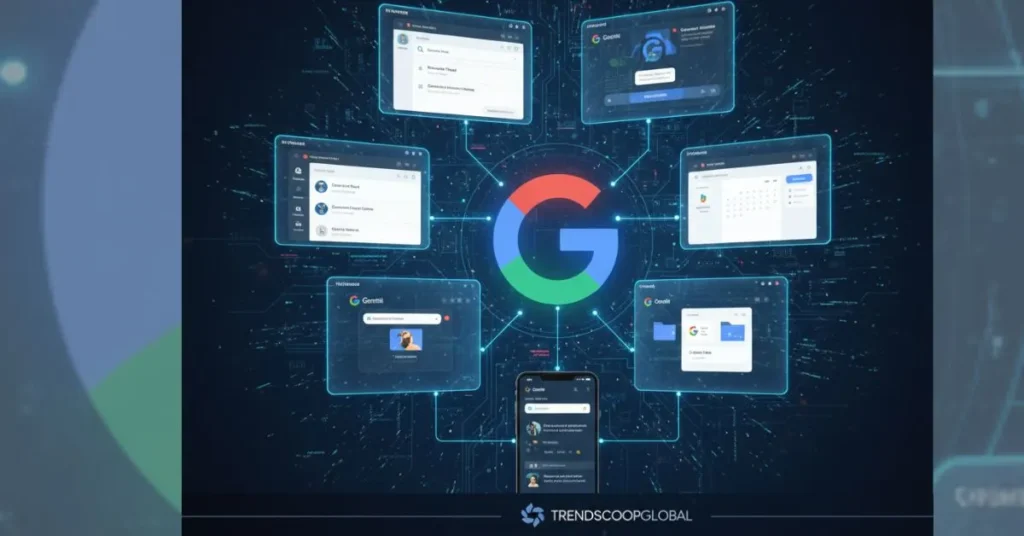
If you live in Google Workspace (Docs, Gmail, Drive), Gemini is your ultimate copilot. In 2026, Gemini isn’t just a standalone tool; it is an integrated layer across the entire Google ecosystem. Its ability to read your emails, summarize your Drive documents, and export directly to Sheets makes it one of the most practical AI chatbots for office productivity.
With the release of the latest models, Gemini has closed the reasoning gap with its competitors, offering multimodal capabilities that allow it to analyze video and images in real-time.
- Best For: Google Workspace users, multimodal analysis (video/images), and seamless data integration.
- Key Weakness: Can be overly cautious or restrictive in its responses due to safety filters.
Deep Dive Resources:
- Confused by the different versions? Read Google Gemini for Beginners: The Ultimate 2025 Guide to the AI Ecosystem.
- Unsure how it compares to OpenAI? Check out our battle of the titans:ChatGPT vs Gemini: The Ultimate 2025 AI Model Family Showdown.
- Ready to apply it? Here are How to Use Google Gemini in Daily Life: 12 Practical Use Cases.
3. Claude: The Specialist’s Choice

Anthropic’s Claude has cultivated a loyal following among developers, writers, and analysts. Known for its massive context window (the ability to read entire books or codebases in one go) and its distinctively warm writing style, Claude is often preferred over other AI chatbots for complex tasks where nuance matters.
In 2026, the rivalry between Claude’s latest iterations and Google’s Gemini series is the hottest topic in tech. Claude excels at following complex instructions without lazy shortcuts.
- Best For: Coding, long-form writing, summarizing massive documents, and nuanced conversation.
- Key Weakness: Lacks the native internet browsing ecosystem of Google or Perplexity.
Deep Dive Resources:
- See how the top models compare in our analysis: Gemini 3 vs Claude 4.5: Which AI Dominates in 2025?.
- Just starting out? We have prepared the Claude 4.5 Beginner Guide (2026): Master Anthropic’s Most Powerful AI.
- Looking for ROI? Discover Claude AI Use Cases in 2025: High ROI Workflows for Professionals & Daily Life.
4. Perplexity AI: The Search Engine Killer

While the others are standard conversationalists, Perplexity is an answer engine. It combines the reasoning of an LLM with a live index of the web. Instead of giving you a creative answer, Perplexity gives you a factual answer with citations.
In 2026, Perplexity has become the go to tool for knowledge workers who need accurate, cited information fast. It is moving us beyond the stupid AI phase where AI chatbots make things up, offering a roadmap to professional productivity.
- Best For: Research, fact-checking, citing sources, and finding real-time information.
- Key Weakness: Less creative than ChatGPT or Claude; focused strictly on information retrieval.
Deep Dive Resources:
- Is it better than a standard chatbot? Read Claude AI vs Perplexity AI: Which One You Should Choose in 2026?.
- Get started with our tutorial: Perplexity AI Beginner Guide (2026): Moving Beyond the Stupid AI Phase.
- Become a power user with Perplexity AI Daily Use Cases (2026): Your Roadmap to Pro Productivity.
- Curious about Elon Musk’s competitor? We compared them in Perplexity vs. Grok 2026: The Ultimate AI Search Showdown.
Summary: Which AI Should You Choose in 2026?
There is no single winner only the right tool for the job. The market for AI chatbots has diversified, allowing you to pick a specialist for every need.
| Feature | ChatGPT | Gemini | Claude | Perplexity |
| Primary Strength | Versatility & Voice | Google Integration | Writing & Coding | Research & Citations |
| Best Use Case | Brainstorming | Office Productivity | Complex Analysis | Fact-Checking |
| Creative Writing | High | Medium | Very High | Low |
| Real-Time Data | Good | Excellent | Low | Excellent |
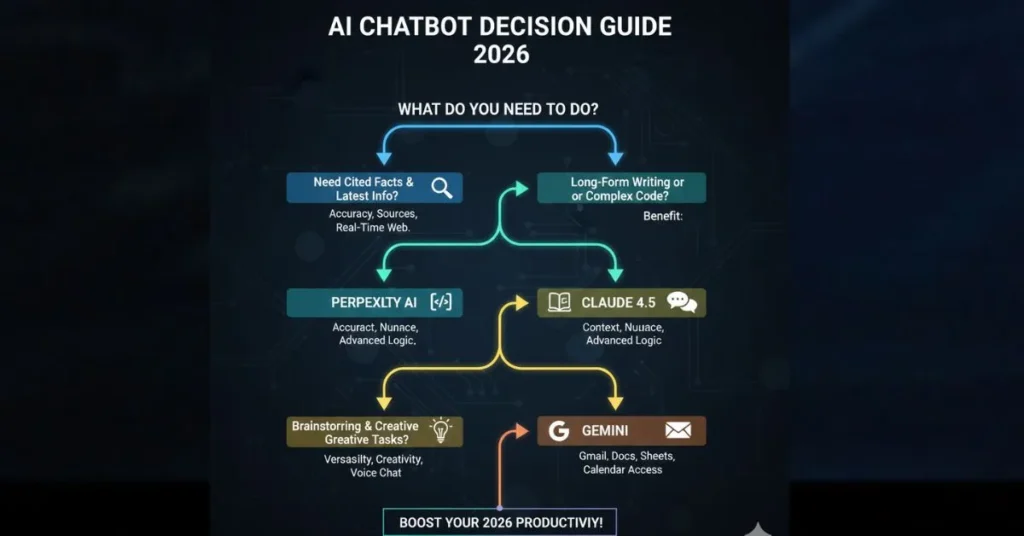
To truly master these tools, you need to dive deeper into the specific guides linked above. By understanding the unique personality of each AI, you can build a technology stack that saves you hours every week.
FAQ
1. Which AI chatbot is the most accurate in 2026?
While accuracy depends on the task, Perplexity AI is generally considered the most accurate for factual research because it provides real-time citations for every claim. For complex logical reasoning and coding accuracy, Claude 4.5 currently leads the market with fewer hallucinations than its competitors.
2. Is there a free version of these AI chatbots?
Yes, all four major platforms offer free tiers:
ChatGPT: Access to the latest mini models and limited use of flagship models.
Gemini: Deeply integrated free access for Google account holders.
Claude: A generous free tier for daily conversational tasks.
Perplexity: Free basic search with limited Pro uses per day.
3. Which AI is better: ChatGPT or Google Gemini?
It depends on your ecosystem. If you want a creative, versatile assistant with the best mobile voice experience, ChatGPT is the winner. However, if you use Google Docs, Gmail, and Drive, Gemini is superior because it can access and organize your personal files directly.
4. Can AI chatbots like Claude and ChatGPT write code?
Absolutely. In 2026, Claude 4.5 is widely regarded as the best for software engineering and complex debugging. ChatGPT is also excellent for quick scripts and learning new programming languages, while Gemini is preferred by developers working specifically in Google Cloud or Android environments.
5. Are AI chatbots safe to use with private data?
Reputable platforms like Anthropic (Claude) and OpenAI (ChatGPT) have significantly improved privacy in 2026, offering Temporary Chats or Enterprise modes where data is not used for training. However, you should never share highly sensitive passwords or unencrypted financial data with any AI.
6. Do I still need Google Search if I use Perplexity AI?
Perplexity AI is designed to replace traditional search for many users. Unlike Google, which gives you a list of links, Perplexity reads those links for you and summarizes the answer. Most users now use Perplexity for finding answers and Google for navigating to websites.

𝑻𝒉𝒆 𝑷𝒖𝒍𝒔𝒆 𝒐𝒇 𝑮𝒍𝒐𝒃𝒂𝒍 𝑨𝒇𝒇𝒂𝒊𝒓𝒔
