
By Dawood Jarral, CFA, Market Policy Analyst | Global Economy
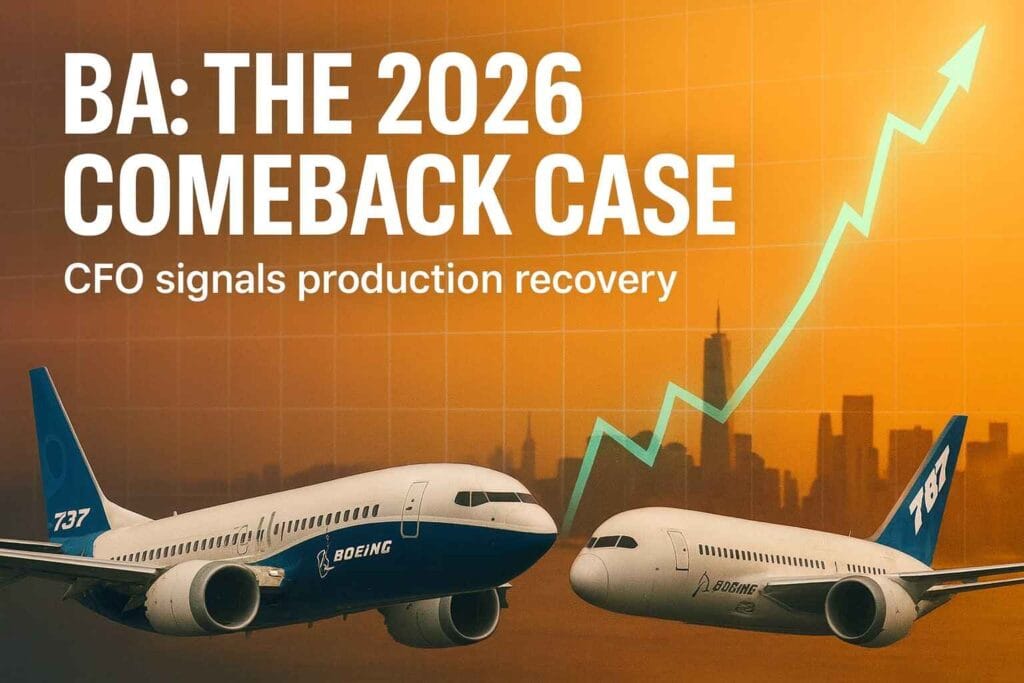
Boeing Stocks ($BA) is back in focus after a renewed wave of bullish momentum, driven by specific commentary from Chief Financial Officer Jay Malave on aircraft delivery targets through 2026. For the first time in years, management is offering clearer visibility on production stability for its two most critical programs: the 737 and 787 Dreamliner.
While the stock has experienced extreme volatility over the past few years due to safety concerns, regulatory pressure, and supply chain constraints, this latest guidance suggests that Boeing may finally be transitioning from crisis management to controlled recovery.
But is this really the turning point — or just another temporary bounce?
What the CFO Actually Said — and Why It Matters
In recent remarks during a UBS conference, Boeing CFO Jay Malave said the company expects higher deliveries of 737 and 787 jets in 2026. Reuters+1
• 737 Program
Boeing sees a pathway toward stabilizing production in the mid-40 range in the nearer term, with potential to move toward 50+ aircraft per month by 2026, subject to regulatory approval and supplier stability.
• 787 Dreamliner
The company expects to stabilize production and work toward a 10 aircraft per month rate within the next two to three years, as quality and certification issues normalize.
This is significant because for most of the past several years, Boeing has avoided committing to explicit forward-rate targets. The shift in tone from damage control to conditional expansion is what the market is responding to.
Why this is important: Aircraft deliveries are Boeing’s primary cash-flow trigger. More planes delivered = more revenue recognized and faster debt reduction.
Translating Production Into Financial Impact
Boeing’s investment story today is less about hype and more about simple math:
- Higher delivery rates → higher revenue recognition
- Higher revenue → improved operating cash flow
- Stronger cash flow → debt reduction + stability
Rough scenario analysis (illustrative, not a forecast):
| Scenario | 737 / Month | 787 / Month | Approx. Annual Output | Likely Impact |
| Bear Case | 35–40 | 6–7 | 500–550 | Recovery delayed, stock remains volatile |
| Base Case | 42–45 | 8–9 | 600–650 | Stable improvement, gradual upside |
| Bull Case | 50+ | 10 | 700+ | Strong multi-year rally possible |
At higher production tiers, Boeing benefits from:
✔ Better unit economics
✔ Supplier cost efficiency
✔ Improved margins
✔ Greater ability to service debt
This is why the 2026 timeframe matters — not because it’s guaranteed, but because it offers line-of-sight.
Why the Market Reacted Positively
The rally in Boeing stock is not just emotional optimism. It is coming from three measurable shifts in sentiment:
- Clarity over ambiguity – investors prefer imperfect data over no data
- Stability over crisis language – management tone has shifted
- Execution narrative over disaster recovery – the story has changed
Markets price the future — and the future, in this case, finally has a framework again.
Technically, the stock has also shown renewed interest near long-term support levels, reinforcing the fundamental narrative.
The Risks That Still Matter (And Cannot Be Ignored)
This is not a “perfect recovery” story yet. Several risks still exist:
1. Supplier Fragility
Many key Boeing suppliers are still recovering from financial strain and labor shortages. Delays at any level can disrupt output.
2. Regulatory Oversight
The FAA remains heavily involved in Boeing production. Certification or quality setbacks could immediately change the narrative.
3. Global Demand Sensitivity
If global airline demand softens due to recession risk, high fuel prices, or interest rates, Boeing’s backlog could become vulnerable.
4. Heavy Debt Burden
Even with improving cash flow, Boeing still carries substantial debt from crisis years. Recovery must be consistent.
This is a turnaround, not a guarantee.
Final Verdict: A Data-Supported Turnaround Setup (Not a Blind “Buy”)
Boeing’s 2026 delivery outlook is meaningful because it represents a return to operational confidence. Combined with improving stability metrics, this creates a legitimate recovery thesis — especially for long-term investors seeking exposure to the global aerospace cycle.
However, this is not a guaranteed winner.
It is a conditional opportunity based on execution. Investors should continue to monitor:
✔ Monthly delivery numbers
✔ FAA developments
✔ Supplier health updates
✔ Free cash flow trends
If Boeing meets even the base-case scenario, the current setup could represent the early stage of a larger multi-year recovery cycle.
Bottom line:
Not a blind “must-buy” — but one of the most credible turnaround cases in the industrial sector right now.
Disclaimer
This article is for informational purposes only and does not constitute financial advice. All investments carry risk. Readers should conduct independent research or consult a licensed financial advisor before making investment decisions.
Why did Boeing stock go up suddenly?
Investors reacted to clearer 2026 delivery guidance from Boeing’s CFO, suggesting improving production stability and stronger future cash flow.
Is Boeing a good long-term investment?
Boeing may present a turnaround opportunity, but it still faces regulatory, supply-chain and debt-related risks that investors should evaluate carefully.
When will Boeing fully recover?
Current guidance suggests 2026 as a key stabilization year, but recovery depends on consistent execution and regulatory approvals.

𝑻𝒉𝒆 𝑷𝒖𝒍𝒔𝒆 𝒐𝒇 𝑮𝒍𝒐𝒃𝒂𝒍 𝑨𝒇𝒇𝒂𝒊𝒓𝒔
