
By Bilal Akram, CFA | Lead AI & Tech Economy Analyst| Last Updated February 20, 2026 | Technology
Agentic AI is no longer a research concept debated in university labs. As of 2026, it is actively managing supply chains in Shenzhen, approving loans in Singapore, and adjusting treatment plans in Tokyo all without waiting for a human to issue a command.
First published November 2025. Updated February 2026: The deployments described here have accelerated. What was early adoption in late 2025 is now operational infrastructure in leading Asian enterprises.
This is the defining shift in artificial intelligence: from systems that respond to systems that act. Understanding what agentic AI is, how it works, and where it is already deployed is not optional for business leaders, technologists, or policymakers. It is essential.
What Is Agentic AI? A Clear Definition
Agentic AI refers to artificial intelligence systems that can perceive their environment, set goals, plan a sequence of actions, execute those actions using tools or APIs, and adapt based on feedback all with minimal human intervention.
The term “agentic” derives from agency the capacity to act independently toward an objective. Unlike a traditional AI model that responds to a single prompt and waits, an agentic AI system breaks a complex goal into sub-tasks, coordinates resources, handles obstacles, and keeps working until the objective is complete.
A useful way to understand the difference:
| Traditional AI | Agentic AI |
| Answers a question | Completes a multi-step workflow |
| Needs a human prompt at each step | Runs autonomously toward a defined goal |
| Single-task focused | Coordinates tools, APIs, and other agents |
| Responds to commands | Sets and pursues its own sub-goals |
The underlying technology typically combines a large language model (LLM) for reasoning, a memory layer for context retention, a tool-use framework for taking real-world actions, and an orchestration layer to manage multiple agents working in parallel.
How Agentic AI Actually Works
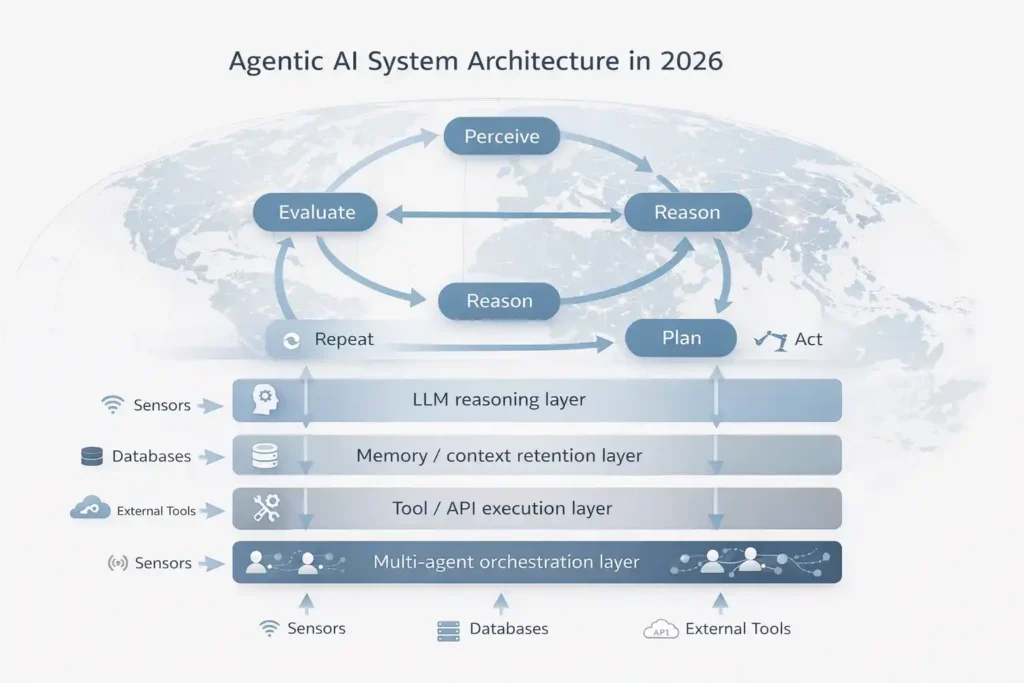
Most agentic AI systems operate through a continuous loop: Perceive → Reason → Plan → Act → Evaluate → Repeat.
At each iteration, the agent takes in new information from its environment whether that is a database, a sensor feed, a web search, or user input reasons through it using an LLM, determines the next best action, executes that action via connected tools, and then evaluates the outcome before proceeding.
This architecture is what separates agentic AI from a chatbot. A chatbot answers. An agent does.
Modern agentic frameworks like LangGraph, AutoGen, and CrewAI allow developers to build multi-agent systems where several specialized agents collaborate one agent researches, another writes, a third reviews, and an orchestrator manages the workflow. This mirrors how human teams operate, but at machine speed.
Why 2025–2026 Is the Inflection Point for Agentic AI
Several converging factors made 2025 the breakout year for agentic AI deployment and 2026 the year it became standard operating infrastructure for early adopters.
LLMs are now reliable enough for multi-step reasoning. Models like GPT-4o, Claude 3.5, and Gemini 1.5 Pro can maintain coherent reasoning chains across dozens of steps without losing context a capability that was inconsistent as recently as 2023.
Tool-use APIs have matured. Agents can now call external APIs, execute code, browse the web, query databases, and trigger actions in enterprise software stacks with high reliability.
Enterprise adoption has crossed the tipping point. According to Gartner’s projections, more than 40% of enterprises are expected to have at least one AI agent operating within their workflows by 2028. Organizations that started in 2025 are already running second-generation systems. Those starting in 2026 are catching up to a moving target.
Asia is leading deployment, not just adoption. While Western markets are still developing regulatory frameworks, China, Singapore, India, and Japan have moved to active industrial deployment at scale.
Entering 2026, the question is no longer whether agentic AI works it is how fast organizations can scale what is already proven.
Agentic AI in Asia: Where Autonomous Agents Are Already Working
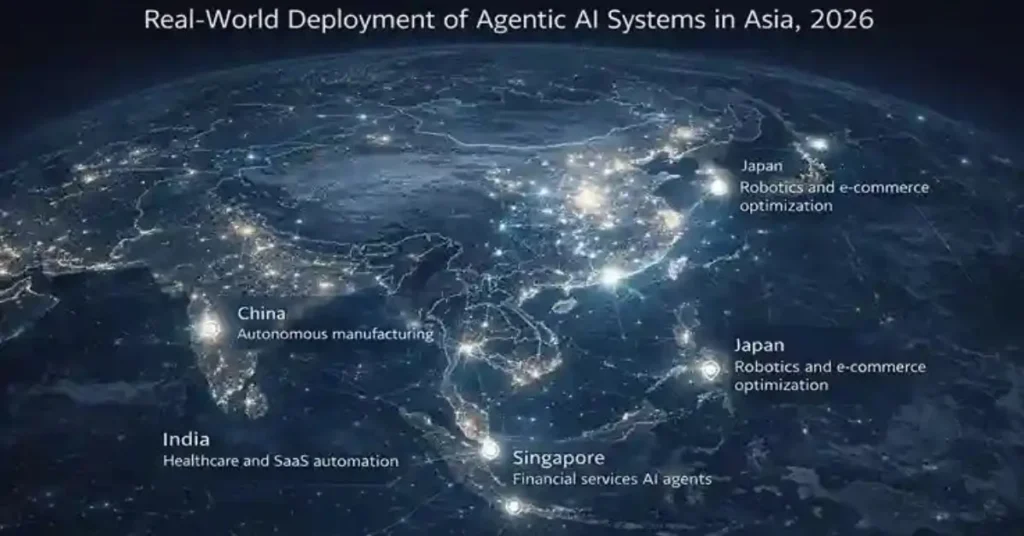
China: Autonomous Manufacturing at Scale
Foxconn’s manufacturing operations in Zhengzhou have integrated agentic AI systems to manage production continuity. These agents monitor component inventory in real time, predict supply shortages before they occur, coordinate with suppliers automatically, and rebalance assembly line workflows without human intervention. The reported result is a 40% reduction in unplanned downtime.
This is not a pilot program. It is how the facility runs.
Singapore: Financial Agents That Operate Around the Clock
DBS Bank has deployed AI agents within its fraud detection infrastructure that process over one billion transactions daily. When anomalous patterns are detected, the agents act immediately blocking suspicious transactions, escalating alerts, and updating detection models in milliseconds. No analyst needs to be on shift for this to happen.
DBS has also deployed “Jim,” an agentic loan processing system that can autonomously approve personal loans under SGD 50,000 based on a defined risk framework, completing in seconds what previously took hours of manual review.
India: Clinical AI That Prepares the Doctor’s Workday
Apollo Hospitals has integrated agentic AI systems that review incoming patient data overnight. By the time a physician logs in, the system has already flagged high-risk cases, ordered relevant diagnostic tests, cross-referenced medication histories for interaction risks, and prepared structured case summaries. The doctor leads the clinical decision; the agent handles the preparation.
Japan: Dynamic E-Commerce Optimization
Rakuten’s agentic AI continuously optimizes its e-commerce platform repricing products, rewriting product descriptions based on engagement data, and running A/B tests on ad creatives on a cycle measured in minutes rather than days. This kind of real-time optimization at scale would require hundreds of human analysts to replicate manually.
Real-World Agentic AI Deployments Across Industries
| Industry | Agent Function | Company / Platform |
| Fashion (India) | Auto-reorders inventory when stock drops below 20% | Myntra Supply Chain AI |
| Healthcare (Japan) | Schedules MRI and prepares patient file pre-consultation | Tokyo University Hospital |
| Finance (Singapore) | Autonomously approves loans under defined thresholds | DBS “Jim” Agent |
| EdTech (China) | Rewrites lesson content dynamically for struggling learners | VIPKid Adaptive AI |
| Logistics (Thailand) | Negotiates freight rates with shipping lines in real time | AI-powered logistics operator |
| SaaS (India) | Writes and deploys its own code patches | Yellow.ai |
The Economic Scale of Agentic AI
McKinsey’s analysis estimates that agentic AI could add between $4.4 trillion and $7 trillion to global GDP by 2030, depending on adoption velocity. The range reflects uncertainty around regulatory environments and integration complexity not uncertainty about the underlying capability.
Asia is positioned to capture a disproportionate share of this value due to manufacturing scale, lower regulatory friction in deployment contexts, and a large base of tech talent comfortable building on LLM frameworks.
| Region | Structural Advantage |
| China | Manufacturing scale and speed of deployment |
| Japan | Precision robotics integration |
| Singapore | Regulatory clarity and financial infrastructure |
| India | Engineering talent and cost-effective development |
| USA | Semiconductor leadership and foundational R&D |
The Workforce Shift: New Roles Agentic AI Is Creating in 2026

The framing of “AI takes jobs” misses the more accurate and more interesting story: agentic AI eliminates tasks while creating roles that did not previously exist.
Emerging roles already appearing in job postings as of early 2026 include AI Workflow Engineers who design and maintain multi-agent pipelines, Autonomy Auditors who review agent decision logs for compliance and bias, and Prompt Systems Architects who build the goal structures that agents operate within.
In India, reinforcement learning with human feedback (RLHF) the technique used to align agent behavior with intended outcomes is now core curriculum in advanced data science bootcamps in Bangalore and Hyderabad. This is a direct market signal: employers are hiring for it.
The skills that protect workers in an agentic AI environment are not about avoiding AI. They are about understanding how to direct, audit, and improve it.
Governance, Risk, and the Accountability Question
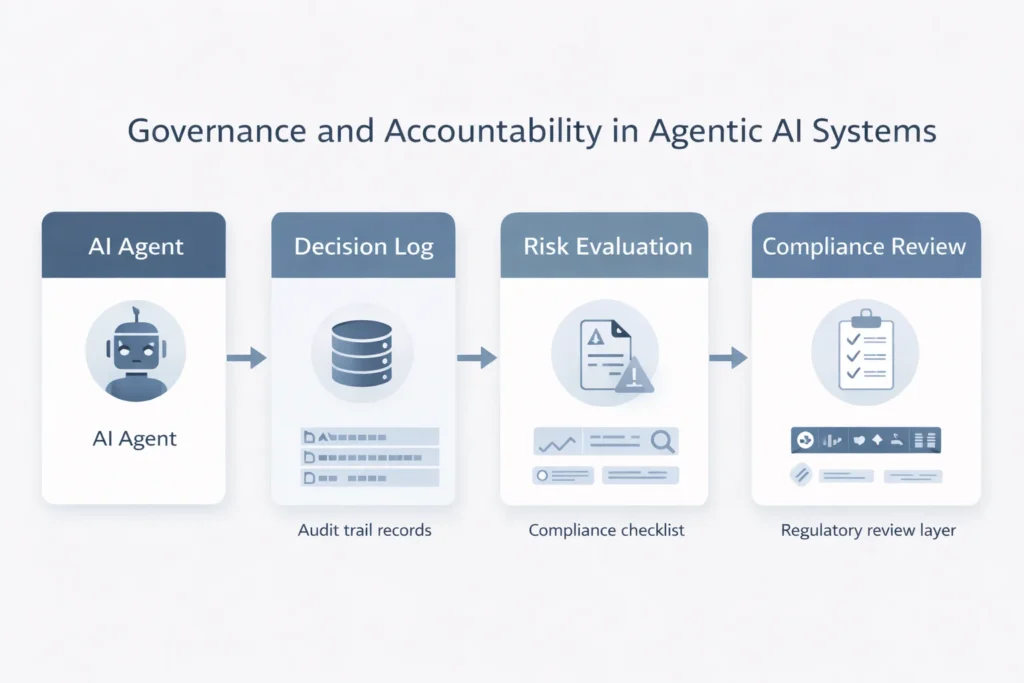
Agentic AI introduces genuine governance challenges that have no precedent in previous technology deployments. When an agent makes a consequential decision approving a loan, routing a medical referral, executing a trade who is accountable for the outcome? Current legal frameworks in most jurisdictions were not designed for autonomous machine actors.
Japan moved further than most with its AI Accountability Law (2025), which requires that every agentic AI system operating in regulated industries maintain decision logs analogous to a flight data recorder a complete, auditable record of every goal, action, and outcome the agent produced. By early 2026, enforcement of this framework is actively underway.
Singapore’s Monetary Authority has issued guidance requiring explainability standards for AI systems used in financial decision-making. India’s evolving Digital India Act is expected to address agentic AI liability in its next revision, anticipated in mid-2026.
The core unresolved questions across all jurisdictions remain: Can an AI agent legally enter into a binding contract? What constitutes sufficient oversight? And who holds liability when an agent produces a harmful outcome at machine speed? These are not hypothetical. They are being litigated and legislated right now.
How to Think About Agentic AI for Your Organization in 2026
If you are evaluating agentic AI for enterprise deployment, the starting point is process mapping. Agentic AI delivers the highest ROI in workflows that are high-frequency, rules-bounded at the edges but judgment-requiring in the middle, and time-sensitive. Fraud detection, supply chain exception handling, customer triage, and document processing are proven entry points.
The organizations losing ground in 2026 are those still waiting for the technology to “mature.” The organizations building durable advantage are those that deployed constrained agents in low-risk workflows in 2025, learned from real operational data, and are now expanding scope systematically. The gap between these two groups is widening every quarter.
FAQ
What is Agentic AI?
Agentic AI refers to autonomous AI systems that perceive their environment, set goals, plan multi-step actions, and execute those actions using tools all with minimal human input.
Is Agentic AI safe?
Agentic AI is safe when deployed with proper guardrails: defined action boundaries, human in the loop checkpoints for high-stakes decisions, and comprehensive decision logging. As of 2026, Japan’s AI Accountability Law and Singapore’s MAS guidelines represent the leading edge of regulatory frameworks designed to ensure responsible deployment. No agentic system should operate in a regulated industry without an auditable decision trail.
Will Agentic AI take my job?
Agentic AI will eliminate specific tasks rather than entire roles in most sectors. It creates new roles AI workflow engineers, autonomy auditors, agent trainers while automating repetitive, high-volume, or time-critical work. Workers who learn to direct, configure, and audit AI systems are significantly better positioned than those who avoid the technology. By 2026, RLHF and agent workflow skills are already appearing as hiring requirements in Asian tech markets.
Where is Agentic AI most developed in Asia?
China leads in manufacturing applications; Singapore leads in financial services; India is a major development hub with growing healthcare and SaaS applications; Japan leads in robotics-integrated agentic systems and regulatory frameworks.
When should a company start deploying Agentic AI?
As of 2026, organizations building now are catching up to early adopters who are already training second and third-generation agents. A practical starting point is identifying one high-frequency, well-defined workflow and deploying a constrained agent with clear success metrics. The operational learning from a real deployment even a small one is more valuable than continued evaluation. The cost of waiting is rising quarterly.
Who originated the concept of Agentic AI?
The conceptual foundation goes back to symbolic AI research in the 1950s and 60s, including early planning systems like STRIPS and autonomous robots like Shakey (1966–72). The modern LLM-powered version emerged in early 2023, accelerated by Auto-GPT by Significant Gravitas and Andrew Ng’s public advocacy for agentic workflows as the next frontier of practical AI deployment. The field has evolved more in the 2023–2026 window than in the preceding two decades.
What is the difference between Agentic AI and traditional AI?
Traditional AI systems perform specific tasks when prompted and produce an output one question, one answer, done. Agentic AI systems receive a goal, decompose it into steps, use tools to execute those steps, handle unexpected obstacles, and continue until the objective is complete without requiring a human to manage each step. The practical difference is the removal of the human bottleneck from multi-step workflows.
Why is Agentic AI considered transformative?
Because most organizational work is not single-question, single-answer. It involves sequences of decisions, actions, and adjustments over time. Agentic AI can execute those sequences autonomously, which means it scales in a way that individual AI tools or chatbots cannot. McKinsey estimates this capability could unlock between $4.4 trillion and $7 trillion in global economic value by 2030 a figure that reflects productivity gains from automating complex, multi-step knowledge work, not just simple task automation.
What are the best examples of Agentic AI today?
Leading production examples as of 2026 include DBS Bank’s “Jim” for autonomous loan processing, Foxconn’s supply chain management agents, and Myntra’s inventory reordering system. In the developer ecosystem, LangGraph and AutoGen are the dominant orchestration frameworks. Salesforce Einstein Agents are the most widely adopted enterprise product. Auto-GPT was the early public proof of concept in 2023; production systems today are more constrained, reliable, and deeply integrated into existing enterprise workflows.

𝑻𝒉𝒆 𝑷𝒖𝒍𝒔𝒆 𝒐𝒇 𝑮𝒍𝒐𝒃𝒂𝒍 𝑨𝒇𝒇𝒂𝒊𝒓𝒔

3 thoughts on “The Disruptive Rise of Agentic AI: When Machines Stop Asking and Start Acting (2025–2026)”