
By Bilal Akram, CFA | Lead AI & Tech Economy Analyst | Published: March 08, 2026
Introduction: The Automation Era Is Over The Autonomy Era Has Begun
For the past decade, businesses have chased automation. They automated invoices, automated emails, automated reports. It was useful. It saved hours. But it was never truly intelligent. Every automated workflow still needed a human to define its rules, maintain its logic, and step in when something unexpected happened.
That paradigm is ending.
Agentic AI workflows for business 2026 represent the most significant operational shift enterprises have faced in a decade. In 2026, a fundamentally different kind of AI has moved from research labs into boardrooms, production systems, and enterprise operations. It is called agentic AI and unlike anything that came before it, it does not wait to be told what to do next. It perceives its environment, reasons through a goal, selects the right tools, executes multi-step plans, and corrects course when results do not match expectations. All of this happens without a human hovering over every decision.
The numbers behind this shift are striking. Gartner projects that by the end of 2026, 40% of enterprise applications will include task-specific AI agents up from less than 5% in 2025. The global agentic AI market has already crossed $7.6 billion, and long-range projections see it hitting $196.6 billion by 2034. According to Capgemini, 93% of business leaders now believe that companies that successfully scale AI agents in the next 12 months will gain a durable competitive advantage over their peers.
This is not a trend on the horizon. It is a structural transformation already underway.
This guide is written for business owners who need to understand the strategic implications, and for technology professionals who need to understand the architecture. Whether you are evaluating your first AI agent deployment or preparing to scale a multi-agent ecosystem, what follows will give you the depth, clarity, and practical grounding to move with confidence.
What Is Agentic AI, and Why Does It Matter to Your Business?
Before exploring workflows, architectures, and real-world use cases, it is worth establishing a precise definition because agentic AI is one of the most misused terms in technology right now.
Agentic AI refers to AI systems that are capable of autonomous goal-directed behavior. They perceive inputs from their environment (data, APIs, user instructions), reason through multi-step plans, select appropriate tools, execute actions, evaluate results, and adjust their approach all within a defined objective and without requiring step-by-step human instruction.
The decisive distinction from earlier AI lies in the concept of the decision loop. A traditional language model responds to a prompt and stops. An agentic system evaluates context, plans a sequence of actions, executes, observes the outcome, and iterates closing a loop that transforms AI from a conversational tool into an operational entity with genuine decision-making scope.
This is why Gartner has placed agentic systems explicitly among the defining strategic technologies for 2026, and why McKinsey’s 2025 global AI survey identified a clear organizational shift not just experimenting with AI, but deeply integrating autonomous systems into core business processes.
The Difference Between an AI Agent and a Chatbot
This distinction is worth making precisely because the market is full of chatbot vendors now calling their products AI agents. The comparison is not subtle it is architectural.
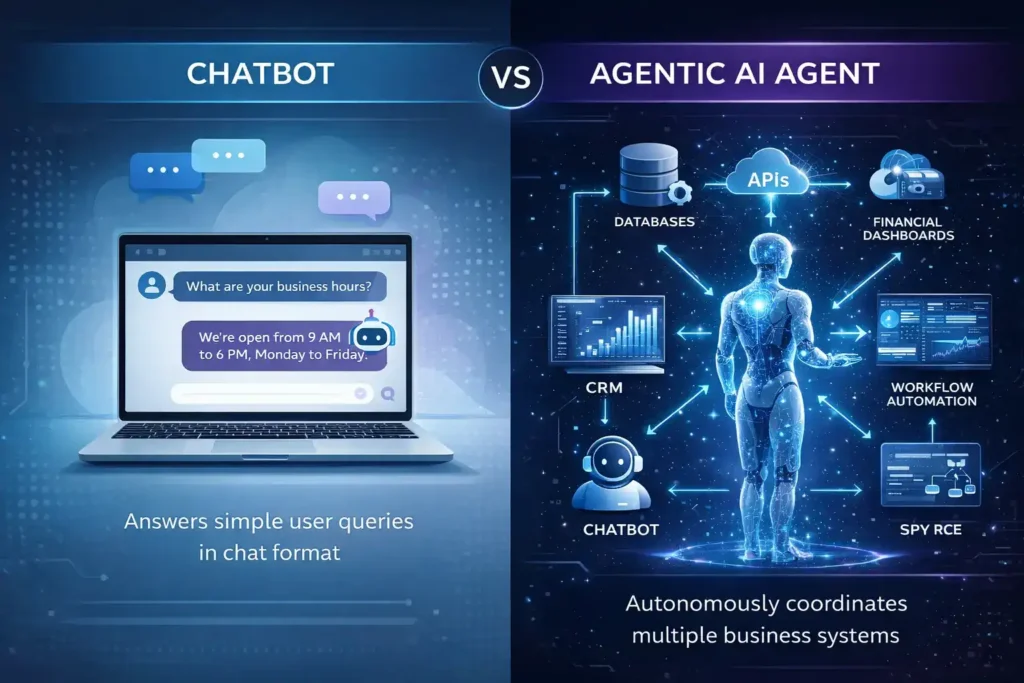
A chatbot responds. An AI agent acts.
A chatbot is reactive: it waits for a prompt, generates text, and returns it. It has no memory beyond the conversation window. It cannot execute code, update a database, trigger a workflow, or coordinate with another system. When the conversation ends, it forgets everything.
An agentic system is goal-oriented: it receives an objective and works backward from it. It selects tools web search, code execution, API calls, database queries based on what the task requires. It maintains memory across sessions. It can hand off subtasks to specialized agents. It tracks intermediate results and adapts when its initial approach fails.
The difference matters practically. A chatbot can help a customer service representative draft an email. An AI agent can resolve the customer’s issue entirely retrieving order history, checking inventory, issuing a refund, sending a confirmation, and logging the interaction without any human involvement.
That is the capability gap that agentic workflows are built to exploit.
The Architecture of Agentic AI Workflows
Understanding how agentic AI actually works is not optional for business leaders who want to deploy it effectively. The failures in agentic AI deployments and there are many, with one analysis suggesting that over 40% of agentic AI projects will be abandoned by 2027 most commonly stem from leaders investing in agent technology without understanding the underlying architecture that makes it succeed or fail.
There are four foundational components that define a production-grade agentic workflow.
1. The Reasoning Core
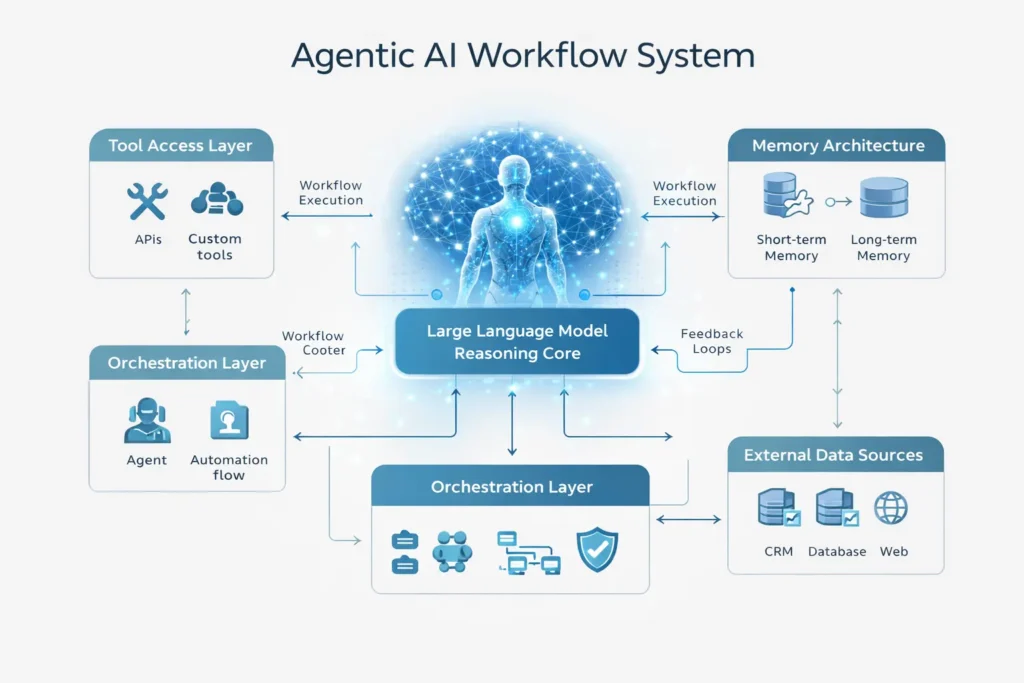
At the center of every agent is a large language model (LLM) that handles planning, reasoning, and decision-making. The model receives a high-level goal, decomposes it into subtasks, evaluates available tools, and determines the sequence of actions needed to achieve the objective.
What separates 2026’s reasoning cores from earlier models is their capacity for sustained multi-step execution. Frontier models can now reason across long-running, multi-step workflows invoking tools, interpreting results, and iterating over time without losing coherent context. This is the technical foundation that makes complex agentic workflows possible.
2. Tool Access and Action Layer
An agent without tools is just a language model. The action layer defines what an agent can actually do in the world: run code, query databases, call APIs, browse the web, send emails, update CRM records, generate documents, or trigger workflows in external systems.
The breadth and reliability of an agent’s tool layer is what determines its real-world utility. An agent with narrow tool access can handle narrow tasks. An agent with rich, secure, well-governed tool access can handle end-to-end business processes.
3. Memory Architecture
Agents that cannot remember are agents that cannot scale. Memory in agentic systems operates at multiple levels: in-context memory (what the agent knows within a current session), external memory (persistent data stores the agent retrieves from), and procedural memory (knowledge about how to complete specific tasks).
For enterprise deployments, external memory connected through Retrieval-Augmented Generation (RAG) pipelines is particularly critical. We will explore this architecture in detail in the next section.
4. Orchestration Layer
In multi-agent systems, an orchestration layer coordinates how individual agents collaborate, delegate tasks, share results, and resolve conflicts. This is where workflow logic lives defining which agent handles which part of a process, how handoffs occur, and how the overall system state is tracked.
Frameworks like LangGraph, CrewAI, and Microsoft’s Semantic Kernel have emerged as the leading tools for building these orchestration layers, each with different strengths depending on the complexity and domain of the workflows being automated.
Agentic RAG: The Architecture That Makes Enterprise AI Actually Reliable
One of the most significant architectural innovations for business AI deployments in 2025 and 2026 is Agentic RAG the fusion of Retrieval-Augmented Generation with agentic reasoning. To understand why it matters, it helps to understand the problem it solves.
Standard large language models have a fundamental limitation for enterprise use: they are trained on static data with a knowledge cutoff date. When you ask them about your company’s current inventory, your live financial position, or the latest regulatory update in your industry, they cannot give you an accurate answer because they do not have access to that information. The result is hallucination: confident, fluent, completely wrong responses.
Traditional RAG addressed this by adding an external retrieval step. Before generating a response, the system fetches relevant documents from an external knowledge base and provides them as context to the model. This dramatically improved factual accuracy for question-answering use cases.
But traditional RAG is still passive. It retrieves information once per query and generates a response. It cannot decide to retrieve additional information when its first retrieval is insufficient. It cannot reformulate its search query when initial results are not relevant. It cannot chain retrieval steps to build a comprehensive answer from multiple sources.
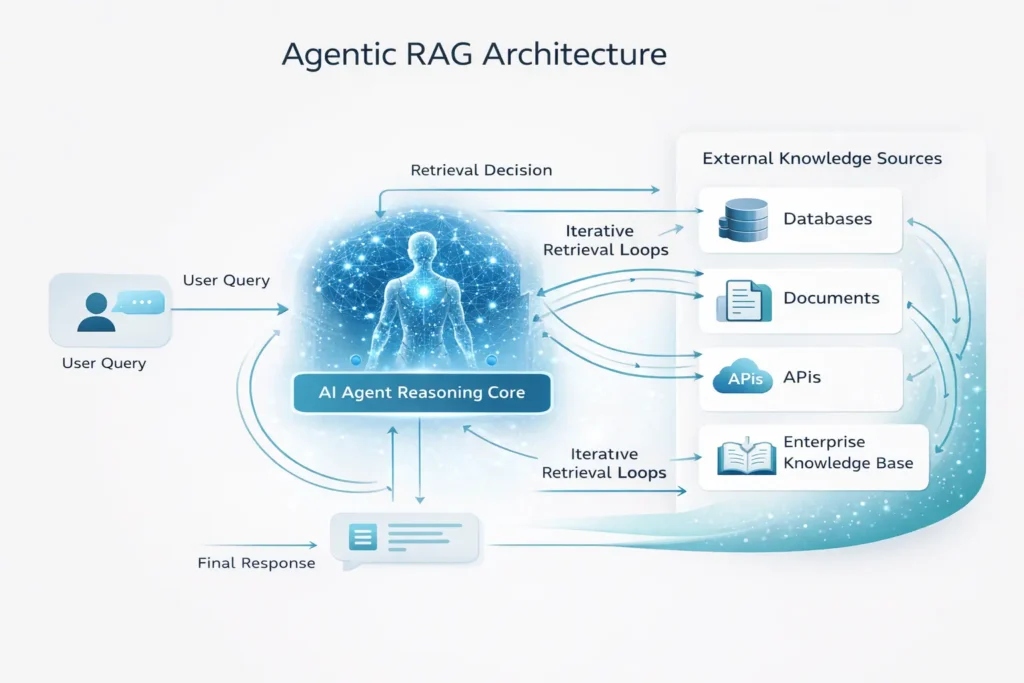
Agentic RAG gives agents the ability to treat retrieval itself as a dynamic, multi-step reasoning process. An agent with Agentic RAG capabilities can decide when to retrieve information, what to search for, how to evaluate the relevance and quality of retrieved results, and whether to refine its query and search again. It combines RAG’s factual grounding with an agent’s strategic reasoning.
The business implications are significant. A compliance assistant with Agentic RAG capabilities can pull the latest regulatory updates from authoritative databases, compare them against existing company policies, identify gaps, and generate a structured compliance report autonomously. A financial analysis agent can retrieve live market data, company filings, and internal portfolio records to produce a comprehensive risk assessment without requiring a human analyst to compile the inputs.
Industry data supports the value of this architecture. Organizations deploying Agentic RAG systems consistently report accuracy improvements of around 50% compared to systems using standard RAG, alongside efficiency gains of 35-45% in targeted workflows. By 2026, analysts project that 75% of enterprise AI systems will use hybrid architectures that combine retrieval grounding with agentic execution making Agentic RAG not an experimental architecture but the emerging standard for production enterprise AI.
Multi-Agent Systems: Beyond Single-Agent Limitations
A single AI agent, however sophisticated, has limits. It can only do so many things at once. Complex enterprise processes span multiple departments, data systems, and decision domains. Trying to handle all of that with a single agent creates bottlenecks, increases error risk, and produces systems that are difficult to maintain and impossible to scale.
Multi-agent systems solve this by distributing work across specialized agents that collaborate, coordinate, and communicate to complete complex workflows. Think of it as the difference between a single generalist employee and a coordinated team of domain experts each one focused on what they do best, operating in parallel, and combining their outputs toward a shared goal.
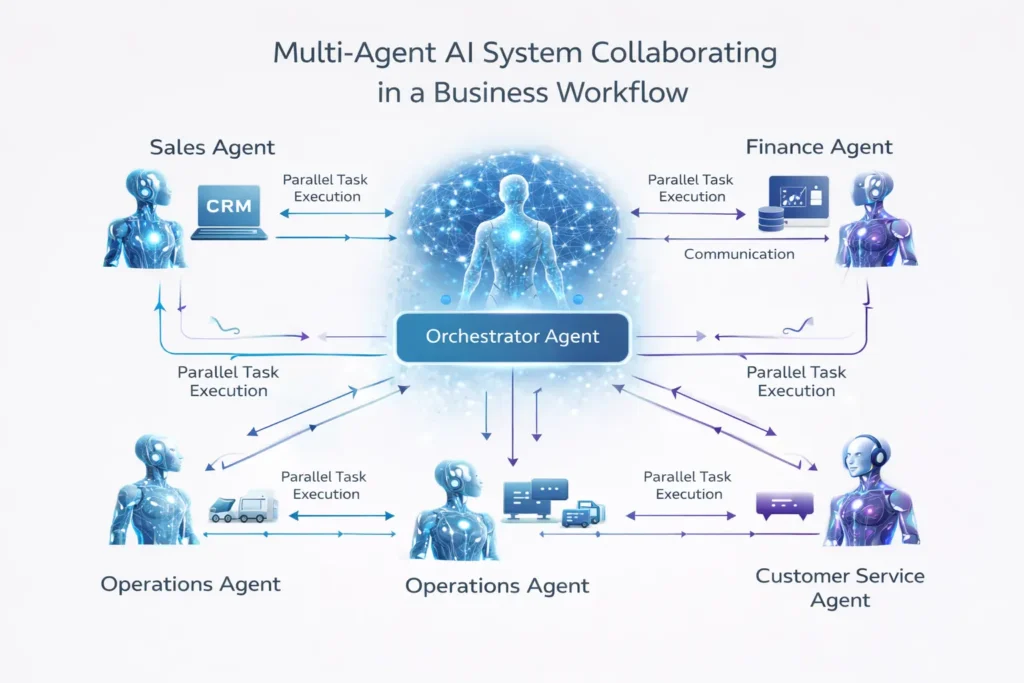
The Kanerika analysis captures the operational power of this architecture well: imagine a sales agent updating forecasts, a finance agent adjusting budgets, and an operations agent scheduling production all working in synchronized sequence without waiting for human handoffs between departments. Frameworks like CrewAI, AutoGen, and LangGraph make this orchestration technically feasible at enterprise scale.
What Makes Multi-Agent Systems Superior in Practice
The advantages of multi-agent architectures over single-agent systems and traditional chatbots accumulate quickly in complex production environments.
Specialization without fragmentation. Each agent can be optimized in terms of model selection, tool access, and memory for its specific domain. A legal review agent might be fine-tuned on contract language and regulatory texts. A financial modeling agent might have priority access to market data APIs and calculation tools. A customer service agent might have deep integration with CRM and order management systems. Specialization improves accuracy and reduces cost per task.
Parallel execution. In a single-agent system, tasks execute sequentially. In a multi-agent system, independent subtasks run simultaneously. A process that previously took hours because each step waited for the previous one can complete in a fraction of the time when parallel agents handle independent streams.
Resilience and fallback. Multi-agent systems can be designed with redundancy. If one agent fails a task, an orchestrator can reroute to an alternative agent or escalate to human review. This architectural resilience is critical for production deployments where reliability is a business requirement, not a nice-to-have.
Scalability. As workflow volume grows, multi-agent systems can scale by adding more agent instances. A single-agent system can become a bottleneck under load. A well-designed multi-agent architecture scales horizontally like microservices without fundamental redesign.
The market is beginning to reflect this shift. The agent orchestration market, which analysts initially projected to reach $30 billion by 2030, may arrive three years ahead of schedule given the speed of enterprise adoption. Early adopters of multi-agent architectures consistently report 20-30% faster workflow cycle times and measurable cost reductions in operations like claims processing, compliance monitoring, and financial reconciliation.
Model Context Protocol (MCP): The Infrastructure Standard That Changes Everything
If multi-agent systems are the operational structure of agentic AI, then the Model Context Protocol (MCP) is the infrastructure that makes them work at scale. It is arguably the most important technical development in enterprise AI integration of the past two years and most business leaders have never heard of it.
MCP is an open standard introduced by Anthropic in November 2024. Its purpose is straightforward: to provide a universal, standardized way for AI systems to connect securely to any data source, tool, or external system an organization uses. Think of it as USB-C for AI. Before USB-C, every device needed its own proprietary cable. Before MCP, every AI integration needed its own custom engineering work.
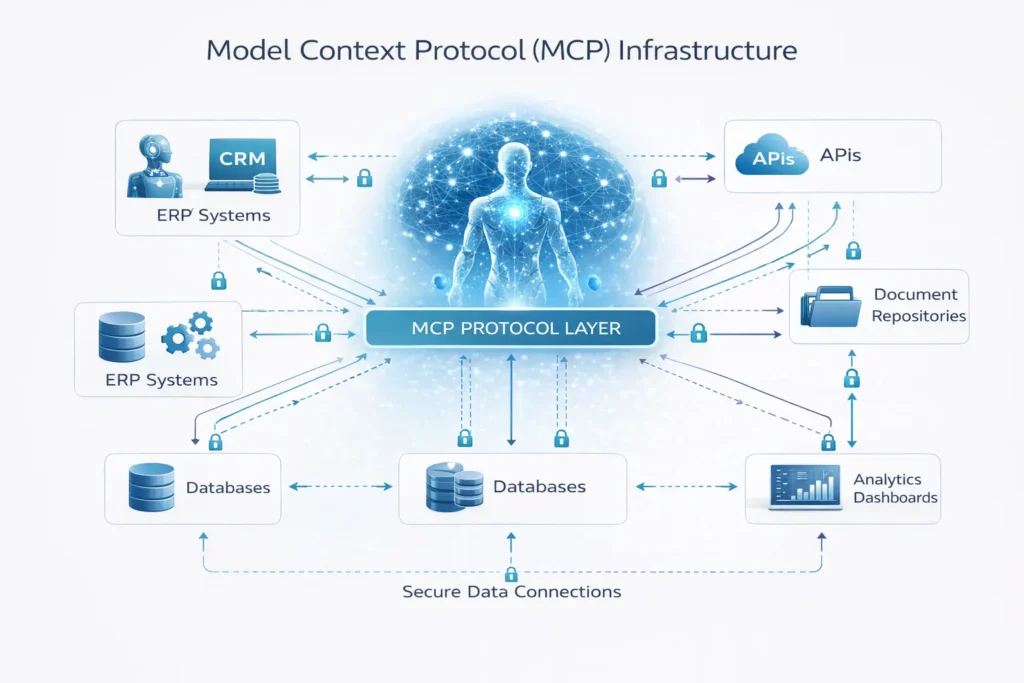
The problem MCP solves is one that anyone who has tried to deploy enterprise AI at scale will recognize immediately. Organizations do not have one system they have hundreds. The average enterprise manages approximately 897 applications, and only about 29% of those can interface with one another. Without a common protocol, connecting an AI agent to your CRM requires one integration. Connecting it to your ERP requires another. Your document management system needs a third. Your financial platform needs a fourth. Each integration is custom-built, requires engineering time, introduces security risks, and breaks when systems update.
MCP eliminates this fragmentation by providing a single, standardized protocol that any compliant AI system can use to connect to any compliant data source or tool. Build the integration once with MCP, and any agent regardless of which model it runs on can use it.
The adoption has been rapid and broad. Within a year of its release, MCP had attracted support from OpenAI, Google DeepMind, Microsoft, Salesforce, ServiceNow, Workday, and thousands of independent developers. MCP server downloads grew from roughly 100,000 in November 2024 to over 8 million by April 2025. By December 2025, MCP was donated to the Linux Foundation as part of the newly formed Agentic AI Foundation ensuring it remains vendor-neutral, open, and community-governed, on par with foundational infrastructure like Kubernetes and Node.js.
What MCP Means for Your Business
For business leaders, MCP has three concrete implications.
Faster deployment at lower cost. Organizations implementing MCP report 40-60% faster agent deployment times compared to custom integration approaches. The standardized protocol eliminates the engineering overhead of building bespoke connectors for every tool and data source. Development teams can build once and reuse across agents, systems, and use cases.
Enterprise-grade security without compromise. MCP was designed with security as a foundational principle, not an afterthought. It provides structured authentication, encryption, and permission management so when an AI agent accesses sensitive business data, it does so through documented, auditable channels with explicit scope control. Organizations can define precisely what data each agent can access and what actions it is permitted to take.
Vendor independence and future-proofing. Because MCP is an open standard supported across major AI providers, organizations are not locked into any single vendor’s ecosystem. An AI workflow built with MCP-compliant components today can incorporate new models, tools, and data sources as the ecosystem evolves without rearchitecting from scratch.
For technology professionals, the November 2025 MCP specification update added the Tasks primitive enabling MCP servers to handle asynchronous, long-running operations with progress tracking. This moves MCP from a call-and-response tool interface toward a full workflow orchestration layer, making it suitable for document processing, analytics jobs, and complex agent coordination at enterprise scale.
Autonomous AI Agents for Financial Analysis: A High-Value Use Case
No industry has moved faster on agentic AI adoption than financial services and the reason is straightforward. Financial workflows combine vast data volumes, strict accuracy requirements, clear measurable outcomes, and regulatory complexity. These are precisely the conditions where agentic AI delivers its highest return.
JPMorgan’s deployment of compliance RAG agents is a widely referenced example. The system autonomously monitors regulatory databases, compares new guidance against existing internal policies, identifies compliance gaps, and generates structured reports a process that previously consumed thousands of analyst hours annually. The bank reported productivity gains of 200 to 2,000 percent in targeted workflows, with individual human practitioners now supervising more than 20 AI agents simultaneously.

Financial analysis is a particularly fertile ground for agentic workflows for several reasons:
Data richness and accessibility. Financial analysis depends on synthesizing information from multiple sources market feeds, company filings, macroeconomic indicators, internal portfolio records, risk models. Agentic systems with Agentic RAG capabilities can retrieve, synthesize, and reason across all of these in parallel, in real time, at a scale no human team can match.
Clear, measurable success criteria. Unlike qualitative judgment tasks, financial analysis produces outputs that can be evaluated against objective standards accuracy of projections, completeness of risk identification, compliance with regulatory requirements. This makes it straightforward to measure agent performance and iterate toward better outcomes.
High cost of human time. Senior financial analysts are expensive. Every hour they spend on data retrieval, formatting, and routine report generation is an hour not spent on the higher-order judgment that actually creates value. Agentic workflows that handle the data-intensive groundwork free human analysts to focus on strategic interpretation and client relationships.
Regulatory imperative. The EU AI Act and sector-specific regulations require financial institutions to maintain detailed audit trails for AI-assisted decisions. Well-designed agentic workflows particularly those built on MCP-compliant architectures produce complete, structured logs of every data access, reasoning step, and action taken. This auditability is not just a compliance feature; it is a risk management necessity.
According to McKinsey, companies implementing agentic AI in financial workflows report revenue increases of 3-15% and sales ROI improvements of 10-20%, with some reporting marketing cost reductions of up to 37%.
The Business Case for Agentic AI Workflows for Business 2026: ROI and Adoption Data
The market data on agentic AI adoption and return on investment is now robust enough to move past speculation. Here is what the evidence shows.
Adoption is accelerating dramatically. As of 2025, 62% of organizations are experimenting with AI agents. 23% are actively scaling agentic systems within at least one business function. By end of 2026, IDC expects AI copilots and agents to be embedded in nearly 80% of enterprise workplace applications. The gap between experimentation and scaled deployment is the central business challenge of 2026 and the organizations closing that gap earliest are establishing durable advantages.
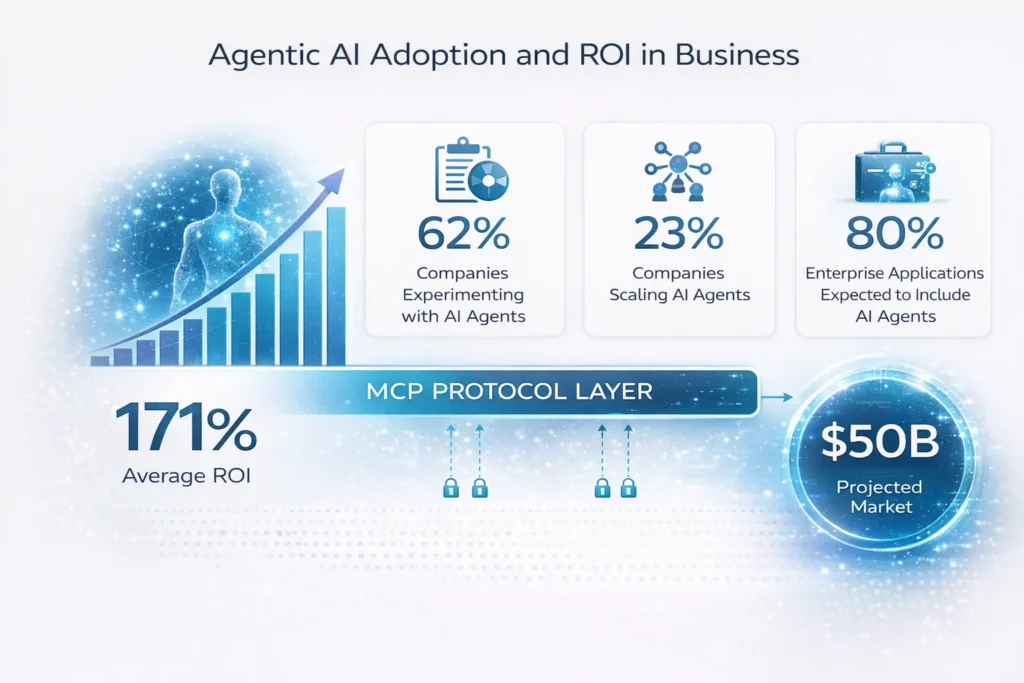
ROI exceeds expectations. Organizations deploying agentic AI workflows report average returns on investment of 171%, with U.S. enterprises achieving approximately 192% exceeding traditional automation ROI by a factor of three. Early adopters in customer experience are 128% more likely to report high ROI compared to organizations that have not deployed agents. 88% of early adopters in a 2025 Google Cloud study achieved positive ROI, compared with 74% of organizations using generative AI more broadly.
Productivity gains are real and measurable. Developers using AI agents complete tasks 126% faster. 90% of companies report more efficient workflows after deploying generative AI agents. 75% of organizations have seen improvements in customer satisfaction scores following agent deployment. Early adopters consistently report 20-30% faster workflow cycles in back-office operations.
The financial scale of the opportunity is enormous. The agentic AI market is projected to surpass $50 billion by 2030. Gartner’s best-case scenario projects agentic AI could drive approximately 30% of enterprise application software revenue by 2035, surpassing $450 billion.
But failure is also common. Only 2% of organizations have deployed agentic AI at scale. 61% remain in exploration phases. McKinsey found that high-performing organizations are three times more likely than their peers to successfully scale agents and the key differentiator is not the sophistication of their AI models. It is their willingness to redesign workflows rather than layer agents onto legacy processes.
This finding deserves emphasis. Organizations that treat agentic AI as a productivity add-on dropping agents into existing workflows without redesigning those workflows for agent-first execution consistently fail to achieve meaningful ROI. Toyota’s experience illustrates the alternative: a supply chain process that previously required 50-100 mainframe screens and significant manual labor was redesigned around an agentic tool, dramatically reducing both time-to-resolution and human effort. The technology alone was not the driver. The workflow redesign was.
How to Build an Agentic AI Strategy That Actually Works
Given the gap between those who succeed with agentic AI and those who do not, a clear strategic framework is essential. The organizations achieving the highest ROI from agentic workflows share five characteristics.
Start with process redesign, not technology selection. Before evaluating which model or framework to use, identify the specific processes in your organization that would benefit most from agentic automation. Look for processes that are high-volume, rule-intensive, multi-step, span multiple systems, and have clear measurable outcomes. These are the workflows where agentic AI delivers its highest value. Redesign them with agent-first thinking not as automation of what humans currently do, but as reimagination of what the outcome requires.
Build on standardized infrastructure. Adopt MCP-compliant architectures from the start. The overhead of proprietary integrations compounds exponentially as you scale from one agent to many. Organizations that invest in MCP-compatible infrastructure early report dramatically faster deployment timelines for subsequent agent initiatives. MCP also provides the security and auditability that regulated industries require.
Match architecture to complexity. Simple, bounded tasks answering customer FAQs, generating routine reports, processing standard form submissions may be well-served by single agents with focused capabilities. Complex, multi-domain processes end-to-end order management, comprehensive financial analysis, cross-departmental compliance monitoring require multi-agent architectures with proper orchestration. Choosing the right architecture for the specific workflow is as important as choosing the right model.
Govern before you scale. The organizations finding success in 2026 are not just building agents they are building governance frameworks alongside them. This means defining clear accountability for agent decisions, implementing tiered autonomy (where high-risk actions require human approval), maintaining audit trails, and establishing feedback loops that catch and correct errors before they cascade. Governance is not an obstacle to agentic AI deployment. It is the prerequisite for deploying it safely at scale.
Invest in your people alongside your technology. Google Cloud’s 2026 AI Agent Trends Report is emphatic on this point: the biggest challenge in agentic AI deployment is not technical it is human. The most successful organizations in 2026 are moving from one-off AI training toward continuous, hands-on learning programs that help employees develop genuine AI fluency. The role of human workers is shifting, not disappearing from execution to orchestration, from doing to directing and validating. Organizations that help their people make that transition successfully will capture far more value from their agentic investments than those that focus exclusively on the technology.
The Competitive Landscape: Who Wins in the Agentic Era
The competitive dynamics of 2026’s agentic AI landscape are being shaped by a tension between established enterprises and what are being called agent-native companies new entrants that bypass traditional software paradigms entirely, designing experiences where autonomous agents are the primary interface rather than a supplementary feature.
Incumbents face a genuine strategic dilemma: cannibalize existing products by building agentic alternatives, or risk disruption by organizations unburdened by legacy architectures. The organizations moving most aggressively on agentic workflows deploying MCP infrastructure, building multi-agent orchestration layers, and redesigning core processes around agent-first thinking are positioning themselves as the incumbents that survive this transition.
The Gartner CEO survey cited earlier found that 34% of chief executives now identify AI as their top strategic theme, replacing digital transformation a concept that dominated boardroom conversations for a decade. This is not just a change in terminology. It reflects a recognition that the companies winning in 2026 are those treating agentic AI as a fundamental reimagining of how their organization operates, not as a productivity enhancement layered on top of existing operations.
Conclusion: The Window Is Open But It Will Not Stay Open Indefinitely
The rise of agentic AI in business is not a future prediction. It is a present reality unfolding at a pace that most organizations have underestimated. The frameworks exist. The infrastructure standards are in place. The ROI evidence is robust. The early movers are already pulling ahead.
What remains is execution and the organizations that execute well are those that approach agentic AI with intellectual honesty about what it requires. Not a technology purchase, but a strategic transformation. Not automation of the past, but reimagination of the future. Not AI layered on broken processes, but workflows redesigned from the ground up for an agentic world.
The window for establishing an early-mover advantage in agentic AI workflows is open. The question is not whether to move, but how quickly and how deliberately.
The enterprises that answer that question well in 2026 will be the ones defining their industries in 2030.
FAQ
Q1: What is agentic AI, and how is it different from regular AI?
Agentic AI refers to AI systems that can autonomously pursue goals through multi-step reasoning and action selecting tools, executing tasks, evaluating results, and adjusting course without continuous human instruction. Regular AI models respond to prompts and stop. Agentic systems operate in a continuous decision loop, making them capable of handling complex, end-to-end business processes rather than isolated queries.
Q2: What are agentic AI workflows for business in 2026?
Agentic AI workflows are automated, multi-step business processes executed autonomously by AI agents. In 2026, these workflows span functions like financial analysis, compliance monitoring, customer service resolution, supply chain management, and document processing. They are characterized by the ability to access real-time data, coordinate across multiple systems, make contextual decisions, and complete tasks from start to finish without step-by-step human oversight.
Q3: What is the Model Context Protocol (MCP) and why should businesses care?
MCP is an open standard created by Anthropic that provides a universal way for AI agents to connect securely to an organization’s data sources, tools, and systems. For businesses, MCP eliminates the need for custom integrations for every tool an AI agent needs to access. It reduces deployment time by 40-60%, improves security through structured permission management, and prevents vendor lock-in by working across all major AI providers.
Q4: What is Agentic RAG and why is it better than standard RAG?
Agentic RAG combines Retrieval-Augmented Generation with agentic reasoning. Standard RAG retrieves information once per query. Agentic RAG allows an AI agent to treat retrieval as a dynamic, multi-step process deciding when to retrieve information, what to search for, how to evaluate results, and whether to refine its search. This produces significantly higher accuracy (approximately 50% improvement) and enables genuinely autonomous research and analysis workflows.
Q5: How do multi-agent systems compare to chatbots?
Chatbots are reactive systems that respond to individual prompts with text. Multi-agent systems are goal-directed networks of specialized AI agents that collaborate, execute parallel tasks, access external tools, maintain memory, and complete complex workflows autonomously. Where a chatbot answers a customer question, a multi-agent system resolves the customer’s issue entirely retrieving account data, checking inventory, processing a refund, sending a confirmation, and logging the interaction without human involvement.
Q6: What ROI can businesses expect from agentic AI workflows?
Organizations deploying agentic AI workflows report average ROI of 171%, with U.S. enterprises averaging approximately 192%. McKinsey data shows revenue increases of 3-15% and sales ROI improvements of 10-20% in organizations implementing agentic AI. Early adopters in customer experience report 128% higher likelihood of achieving high ROI compared to non-adopters. The key determinant of ROI is not the technology itself, but whether workflows are redesigned around agent-first thinking rather than simply layering agents onto existing processes.
Q7: What are the biggest risks in deploying agentic AI in business?
The primary risks include deploying agents without adequate governance frameworks, integrating agents into legacy workflows without redesigning those workflows, inadequate data architecture that prevents agents from accessing the context they need, security vulnerabilities from poorly governed tool access, and over-reliance on agents in high-risk decision domains without appropriate human oversight. Gartner projects that over 40% of agentic AI projects will be canceled by 2027 due to escalating costs, unclear business value, or inadequate risk controls underscoring the importance of strategic planning over rapid deployment.
Q8: Which industries benefit most from autonomous AI agents?
Financial services, healthcare, manufacturing, and customer service lead in agentic AI adoption and measurable impact. Financial services organizations benefit from AI agents handling compliance monitoring, financial analysis, and risk assessment. Healthcare organizations use agents for patient triage and administrative workflow automation. Manufacturing companies apply agents to supply chain optimization and predictive maintenance. Customer service operations across industries use agents to handle issue resolution end-to-end. That said, agentic AI’s benefits are not industry-specific any organization with high-volume, multi-step, data-intensive workflows stands to benefit substantially.
Article last updated: March 2026. All statistics and projections sourced from Gartner, McKinsey, Deloitte, Google Cloud, IDC, Capgemini, and PwC research published between 2025 and early 2026.

𝑻𝒉𝒆 𝑷𝒖𝒍𝒔𝒆 𝒐𝒇 𝑮𝒍𝒐𝒃𝒂𝒍 𝑨𝒇𝒇𝒂𝒊𝒓𝒔

Formelan gel – crema intimo che fa discutere.
È importante parlare di formelan new. Frequentemente,
formelan cos’è è inteso come un prodotto complesso.
Vediamo insieme formelan effetti collaterali. L’argomento formelan funziona va approfondito.
Come acquistare formelan? Molti si chiedono formelan farmacia.
È importante sapere che formelan amazon sono
tra le opzioni.
Formelan truffa o prodotto reale? Secondo le formelan forum, la crema sembra con feedback positivi.
Formelan come si usa? Gli ingredienti di include elementi naturali.
Formelan gel controindicazioni è bene conoscerle prima dell’uso.
Per riassumere, formelan 2 è una scelta da valutare per gli uomini che desiderano risultati concreti.
https://formelan.it/
Brawl Pirates casino – slot apprezzata nei casino online.
Molti utenti cercano informazioni su brawl pirates casino.
Spesso, brawl pirates 1win è inteso come un’ottima scelta.
Vediamo insieme brawl pirates 1win hack download. La questione di brawl
pirates 1xbet merita attenzione particolare.
Brawl Pirates slot demo – è disponibile online? Molti
si chiedono brawl pirates casino game. Inoltre brawl pirates argentina rappresentano piattaforme popolari.
Brawl Pirates download Molti giocatori cercano stickman pirates brawl 3v3 mod apk.
L’applicazione stickman pirates – brawl 3v3 mod apk è
disponibile.
Brawl Stars Pirates – modalità speciale molto atteso.
Leggendo le brawl pirates казино, la versione pirates appare con ottime valutazioni.
Per riassumere, pirates brawl rappresenta una scelta da valutare per chi ama giochi
a tema pirati.
https://sites.google.com/view/brawl-pirates/
From the insightful commentary to the captivating writing, every word of this post is top-notch. Kudos to the author for producing such fantastic content.
Your writing style is so relatable and authentic It’s a breath of fresh air in a world filled with superficiality and pretense